Products
- Hall
- DLTS
- Modular
- Customized
Company
- Profile
- Contact
- Partners
Support
- Information
- Downloads
- FAQ
Links
- Physics
| FAQ's to Software | FAQ's to Install |
-
Where can I find the used equations?
The equations for the Schottky diode are in the file equ_1.hp in the directory \Dlts\Dltfs\Text\InfoText, the equations for the Fourier evaluation are in the file equ_2.hp. These are binary files for the HP LaserJet's. You can print it out by the DOS command COPY /B equ_1.hp LPT1 if your printer is connected with LPT1. You can also print these file in the global help menu A.1.6.5 of the DLTS program. If you dont have these files load equ_1.hp and equ_2.hp for the HP LaserJets's or equ_1.hpd and equ_2.hpd for the HP DeskJet's. Click here for Schottky or Fourier equations on the screen. -
How tau will be calculated?
There are 2 methods to calculate the emission time constant. At the direct analysis tau will be calculated directly for every transient (if possible) from the coefficents. For example tau(a1,b1)=Tw/2pi*b1/a1. See in the global help or FAQ for the equations. At the maximum analysis you define by the period width Tw your time constant for the coefficient maximum. This value is only valid in the maximum and depends from Tw, Tw/t0 and the type of coeffcient. This value will be calculated numerical by simulation and maximum search of the cofficient(tau) curve. -
Why there are differences in the activation energy between maximum analysis
and direct analysis?
The calculation of the time constants (shown in the Arrhenius plot) are completely different to each other. It should be the same for a pure exponential transient. It should be similar if the data class of the direct analysis is better than 60. Only for a class higher than 60 a direct analysis is realy valid. The standard should be the maximum analysis with two period widths. An Arrhenius plot with only one constant period widths file is only for an estimated energy and can implement a great error. -
How can I calculate the energy from one temperature point?
If you want to calculate the energy from isothermal measurements (ITS or transient) you need the capture cross section. So you must be carefull with the energy result because it depends at the capture cross section defined by the user. Normally you get this capture cross section from an Arrhenius plot or the value is known. To measure direct the capture cross section in the isothermal module you need normally a fast pulse generator because the short capture time constants. -
There is activation energy (0.360 eV) in "Input of sample parameters",
and in "Trap profile (direct)". What the energy means?
The activation energy (identical with trap energy) given in "sample parameters" is used for calculation of an estimated capture cross secton for a measured transient. You see, the emission time constant (that is what you see in the transient) depends of the energy and the capture cross section. Some times it is useful to check whether the capture cross section is in a correct magnitude. The energy is also used for calculation of space charge region. -
What are the used correlation functions?
You get plots and explainations for all used correlation functions in the menu 6.1.2.3.3.5.5 and in the global info menu A.1.6.5. -
How looks the double correlation function?
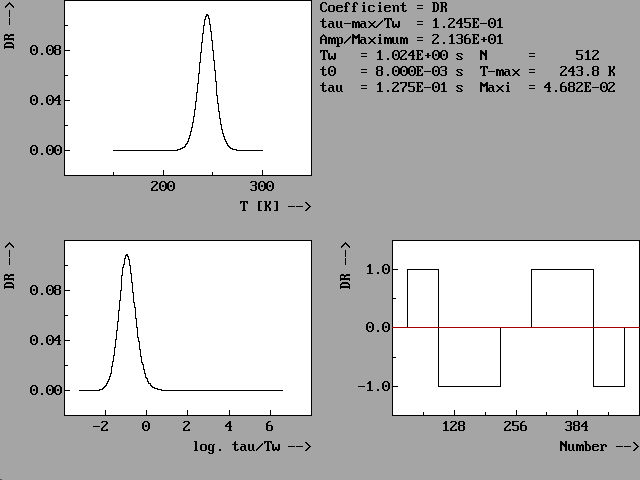
You get an overview about all used correlation functions in the menus A.1.6.5 and 6.1.2.3.3. Click here for a graphic of the double correlation function. -
It is possible to measure ITS by one transient?
It is not possible. If you want to measure time constants from 10 ms to 1000s as you have done with the GaN sample you need for the 10 ms time constant at least 100 point to detect it (100 micro s sampling intevall). This gives you 10000000 points per transient for the 1000s time constant. This is to much for any transient recorder. On the other hand you can not use the filter. The filter frequency is dependant from the sampling interval. Small intervals mean a lot of noise so we have to average a lot. If you average a lot with a 1000s second transient you also have a very long measurement time. At the end you can not get the same results at faster measurement time as at longer one, thats a physical law. Even if you would use a logarithmic sampling you would not get the signal to noise ratio that we have, and a logarithmic sampling is not possible with our system( and it´s not useful to do it). The measurement you have done, shows the great stability of the system (6 h measurement time and all point are correct). You only can reduce the total measurement time by heating up the sample, so that you do not need to go to 3000 s period width and / or enlarge the factor between the periode widths, means the number of points in the ITS spectra. The other thing I have seen on your data, is that you have used a 300s pulse. This 300s pulse is also used for the fast measurements that normally last 1 to 10 seconds. This also makes the measurement time very long. If the long pulse is not necessary, you should reduce it to a second or so.
| FAQ's to Software | FAQ's to Install |